When the remote desktop connexion between a Windows desktop and its host fails, it's time to exercise some remote desktop troubleshooting by checking firewalls, security certificates and more.
In that location are many remote desktop connection bug that administrators may meet, including network failure, Secure Sockets Layer certificate issues, authentication troubles and chapters limitations.
As a desktop admin, you tin prevent and solve common remote desktop problems by using these tips.
one. Network failure
A lack of a valid communications path can prevent a customer from connecting to a remote desktop session. The easiest manner to diagnose this issue is through the process of emptying.
Start, try to institute a session from a client that has been able to successfully connect in the by. The goal is to find out if the problem is specific to an individual customer, the network or a terminal server/Windows server.
If you suspect the network might be to blame, try to narrow downwards the telescopic of the issue to find the root cause. In doing and so, you might notice that the trouble affects wireless connections only non wired ones. Likewise, yous may discover the problem is unique to VPN traffic or a particular subnet.
Some organizations configure their corporate firewall to block outbound RDP traffic, thereby preventing connectivity to remote systems.
ii. Firewall bug
It's easy to dismiss the notion that a firewall could contribute to a remote desktop not working, but it's quite mutual. To avoid firewall problems, ensure that the port your remote desktop software uses is open up on whatsoever firewalls residing between client computers and the server they connect to. Remote Desktop Protocol (RDP)-based tools use RDP port 3389 by default.
You may need to configure multiple firewalls. For example, the customer and the server may both run Windows Defender Firewall, and there will probably be 1 or more hardware firewalls between the two systems.
Some public networks block RDP traffic. This setting is specially common for Wi-Fi networks found in some hotels, airports and coffee shops.
Firewall service issues also may come into play when you employ RDP to admission a home estimator while at piece of work. Some organizations configure their corporate firewall to block outbound RDP traffic, thereby preventing connectivity to remote systems.
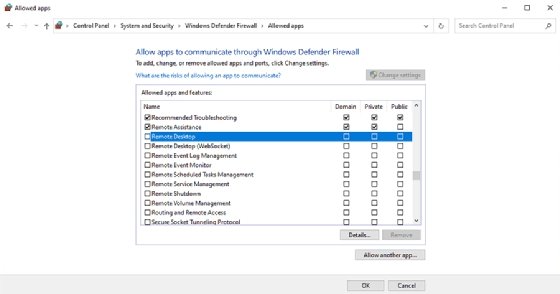
You tin check to brand sure that the Windows Defender Firewall service allows RDP traffic by completing these steps:
Open up the Control Panel by entering Control at the Windows Run prompt
Click Arrangement and Security
Click Windows Defender Firewall
Click Allow an App or Feature Through Windows Defender Firewall
Select the Remote Desktop option
Click OK
The Control Panel setting that shows Windows Defender Firewall assuasive RDP traffic on port 3389
3. SSL certificate issues
Security certificates tin also cause remote desktop connection problems. Many VDI products use Secure Sockets Layer (SSL) encryption for users that admission VDI sessions exterior the network perimeter. But SSL encryption requires the use of certificates, which creates two problems that can cause a remote desktop to non work.
Starting time, if remote desktops are going to connect properly, client computers must trust the certificate authority that issued the certificate. This isn't normally a problem for organizations that buy certificates from large, well-known regime, but clients won't ever trust the certificates an organization generates in-firm. Utilize a reliable document authority to ensure that clients plant remote desktop connectivity.
If you're using a certificate provided by an enterprise certificate authority, it is important to note that network clients do not automatically trust the document. You lot will need to download a re-create of the certificate potency's root certificate and add it to the customer'due south certificate store in a way that allows it to trust the certificate authority associated with the document.
The client must too be able to verify the certificate the server uses. The verification procedure can break down if the certificate has expired or if the name on the certificate doesn't match the name of the server using it.
To check if your network endpoint trusts your certificate authority and import any required certificates, complete these steps:
Enter the MMC command at the Windows Run prompt
Select the Add / Remove Snap-In Control from the File menu
Choose Certificates from the list of available snap-ins and click Add
When prompted, cull the Figurer Business relationship option and click Next
Choose the Local Reckoner choice and click Finish
Click OK
Navigate through the panel tree to Certificates (Local Figurer) \ Trusted Root Certification Authorities \ Certificates
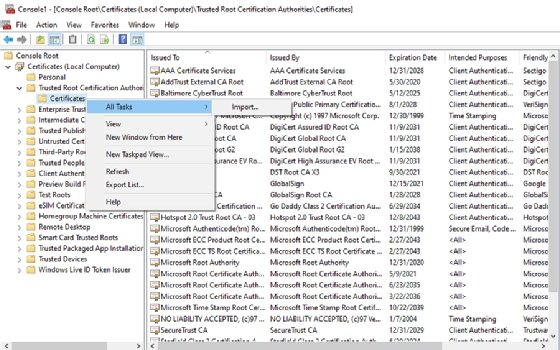
Browse the list of certification authorities to brand sure that your certificate authorisation is listed. If not, correct-click on the Certificates container and choose the All Tasks | Import options
The option to import a root document that you lot need your endpoints' firewall(due south) to trust
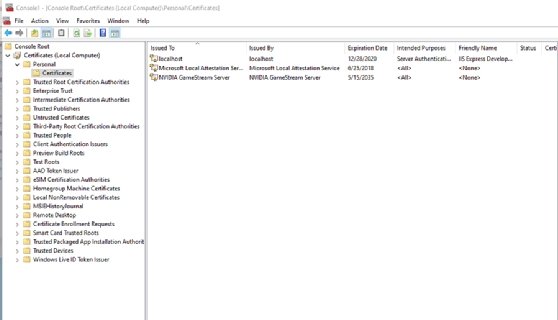
After verifying -- and importing, if necessary -- the root document that will let Windows to trust the SSL certificate, information technology is necessary to bank check for the beingness of the SSL certificate. Navigate through the console tree to Certificates (Local Computer) | Personal | Certificates
If the SSL document does not be or has expired, right-click on the Certificates container and choose the All Tasks | Import commands from the shortcut menus
Follow the prompts to import the certificate
The listing of trusted SSL certificates for the firewall
4. DNS problems
Many remote desktop connectivity issues can be traced to DNS bug. If an admin inverse a host'due south IP address, then clients might not exist able to connect to the host until the client's DNS resolver enshroud expires. To expire a DNS resolver enshroud, follow these steps:
Open an elevated Command Prompt window past inbound the CMD control at the Windows Run prompt.
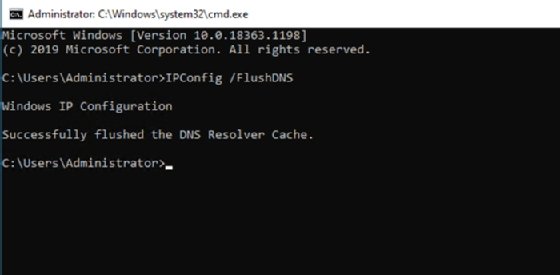
Enter the IPConfig /FlushDNS control.
The process for resolving the DNS cache
Clients may also have trouble connecting to a host if they utilize an external DNS server that is unable to resolve hosts on the organization's private network. The fix for this trouble is to modify the client's IP address settings and so information technology uses one of the organization's DNS servers rather than an external DNS.
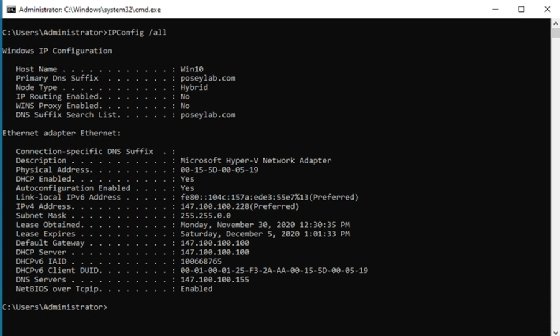
As an culling, you may be able to connect to a remote system by specifying its IP address rather than a host name. To determine whether an endpoint is continued to the right DNS server, consummate the post-obit steps:
Open up a Command Prompt window by entering the CMD command at the Windows Run prompt
Enter the IPConfig /all control
Verify that the correct DNS server is being used with the Preferred network adapter. If the DNS server listed is wrong, and so you can manually specify a different DNS server in the PC's IP address backdrop or configure the PC to use a DHCP server
The process to verify that a PC is pointed to the proper DNS server
5. Insufficient permissions
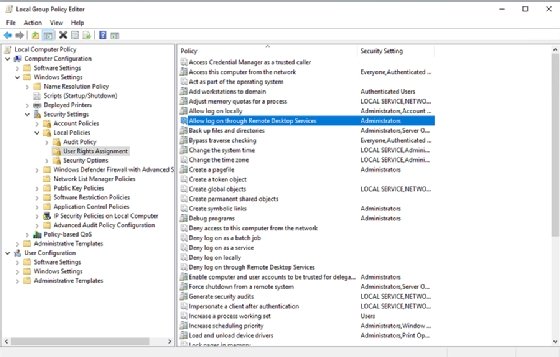
For users to access a remote resources through the Remote Desktop Services, formerly known as Terminal Services, you lot must assign them the Logon Through Remote Desktop Services right. Otherwise, the users volition receive an error when they try to connect to the remote resource. To make sure you have the proper permissions assigned, consummate these steps on the remote server:
Open the Group Policy Object Editor past entering the GPEdit.msc command at the Windows Run prompt
Navigate through the console tree to Computer Configuration \ Windows Settings \ Security Settings \ Local Policies \ User Rights Consignment
Double-click on Allow log on through Remote Desktop Services
Add the necessary groups and click OK
Verifying that the endpoint has the right permissions to access Remote Desktop Services
6. Capacity exceeded
You could also experience remote desktop connectivity issues if yous exceed infrastructure capacity. In an organization with virtual desktops or VDI, for example, clients may exist unable to connect if the available licenses have been depleted. Some VDI implementations also refuse client connections if the server is too busy or if launching some other virtual desktop session would weaken the functioning of existing sessions.
seven. Dropped connections
Sometimes the client can found an RDP session, just the available bandwidth is inadequate to back up the session'south requirements. Depending on the RDP client used, this trouble can manifest itself in a variety of ways.
The session may appear to freeze, or you might meet a black screen. In some cases, the customer may drib the connection and display a bulletin that says 'Reconnecting.' The reconnecting message might besides display if the host reboots during the session. This could occur if you lot have recently installed a Windows update.
If you suspect at that place might not be plenty bandwidth to support the RDP session, effort closing any applications that may be consuming bandwidth. If users are working from home, they should consider shutting down any other devices -- for example, someone streaming Netflix in another room -- that may exist consuming internet bandwidth.
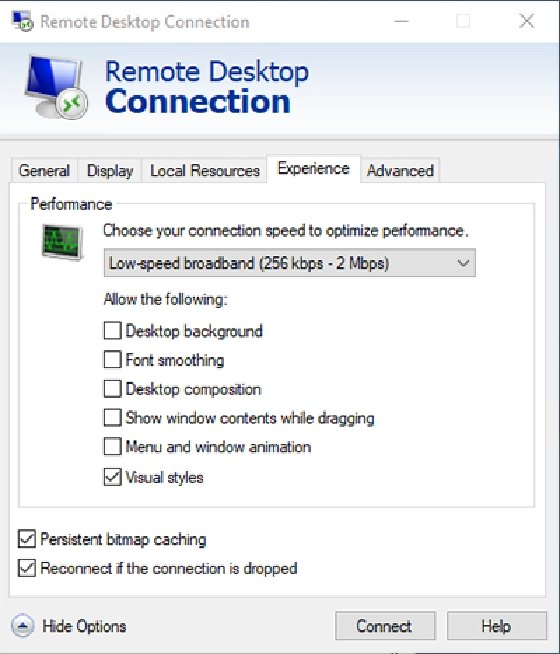
Yous can adjust the RDP client to utilize a lower brandish resolution or color depth and disable visual features such as font smoothing or the Windows background. To reduce the bandwidth consumption of the native Windows RDP client, follow these steps:
Open the RDP client
Expand the console by clicking on the Prove Options link
Select the Experience tab
Select the Low-speed broadband pick from the drop-down menu
Click Connect
The remote desktop session Windows with the depression-speed broadband choice selected
8. CredSSP problems
RDP connectivity tin can sometimes fail due to bug with the Credential Security Back up Provider (CredSSP) protocol. The CredSSP provides a means of sending user credentials from a customer reckoner to a host computer when an RDP session is in utilise.
In 2018, Microsoft updated the CredSSP to fix a security vulnerability. Now, the RDP simply works if both the client and the RDP host use an updated CredSSP provider. If a system does not include an upwards-to-appointment CredSSP provider, the customer volition typically display an hallmark fault. Depending on which RDP client you use, this mistake may even indicate that the consequence was acquired by CredSSP.
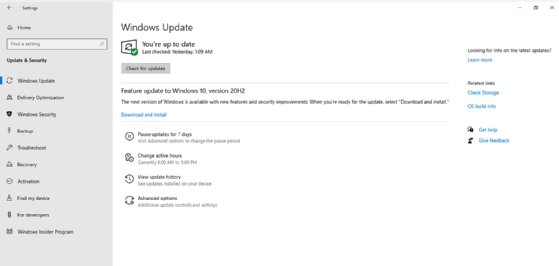
The all-time way to ready this is to ensure that both the client and the host are running supported Windows versions and both systems are fully updated. Yous can access Windows Update by:
Click on Settings
Click Updates & Security
Select the Windows Update tab
Click Check for updates
Verifying that the RDP server and the users' Windows 10 systems are fully up to date.
You tin can prevent most of these connection problems from persisting with some preplanning, and practiced remote desktop troubleshooting skills.
0 Response to "Linux Lost Remote Connection Go Into Running Process Again"
Post a Comment